
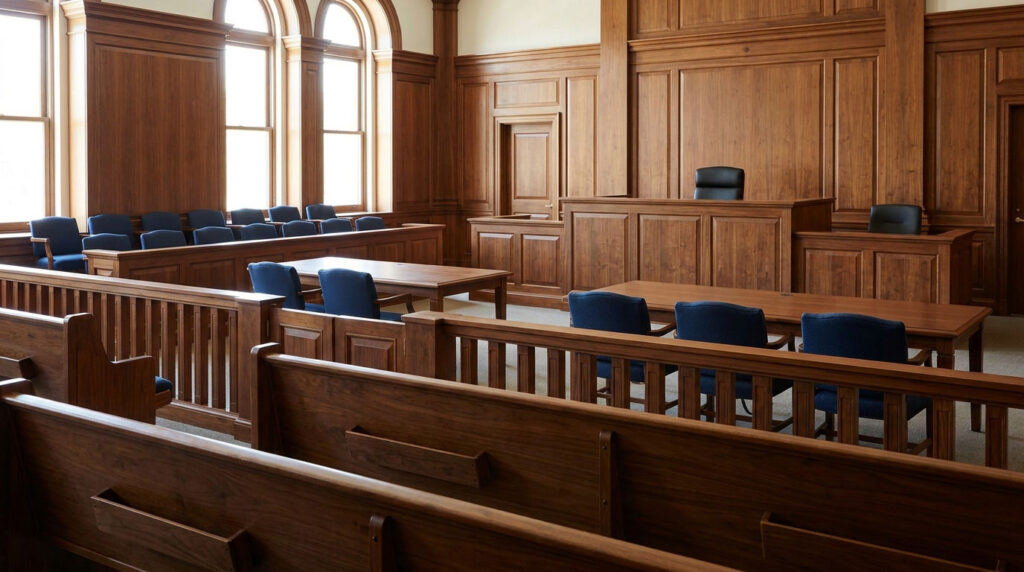
What happens during a trial? In a typical jury trial, the court selects jurors, attorneys introduce their cases, witnesses testify, and evidence is examined. After closing arguments and legal instructions, jurors deliberate and return a verdict. A judge decides the facts instead when the case is tried without a jury.
This guide explains the main stages of U.S. trials, with important distinctions between civil lawsuits and criminal prosecutions. Procedures vary between federal and state courts, so the sequence below is a general overview rather than a universal courtroom checklist.
Before Trial: Understand the Type of Case
In a civil case, a plaintiff brings a claim against a defendant, often seeking compensation or another remedy. As the U.S. Courts’ civil case guide explains, the usual proof standard is a preponderance of the evidence: the claim must be more likely true than not. Some civil issues require a higher standard.
For example, a contract dispute may turn on whether a promised payment was made, rather than whether someone committed a criminal offense.
In a criminal case, the government prosecutes alleged offenses and must prove guilt beyond a reasonable doubt. The defendant is presumed innocent and does not have to prove innocence. These differences matter throughout the trial, from opening statements to the judge’s final instructions.
Step 1: The Court Resolves Pretrial Issues
Preparation begins before anyone addresses a jury. Parties identify witnesses, review records, and exchange information under applicable discovery rules. Civil and criminal disclosure obligations differ; they are not interchangeable.
The judge may resolve disputes about evidence, the issues to be tried, and courtroom procedures. The Department of Justice explains that pretrial motions can request decisions such as excluding evidence or dismissing charges. Not every case reaches trial: civil disputes may settle, and criminal cases may end through guilty pleas.
Step 2: Jurors Are Selected
When a case will be decided by a jury, prospective jurors answer questions about their backgrounds, experiences, and possible biases. This process is called voir dire. A summons does not automatically mean someone will serve on a particular trial.
The federal juror selection process helps determine who can consider the evidence impartially. Jury sizes and selection rules vary. In a bench trial, there is no jury-selection stage because the judge decides factual issues as well as legal questions.
Step 3: Attorneys Give Opening Statements
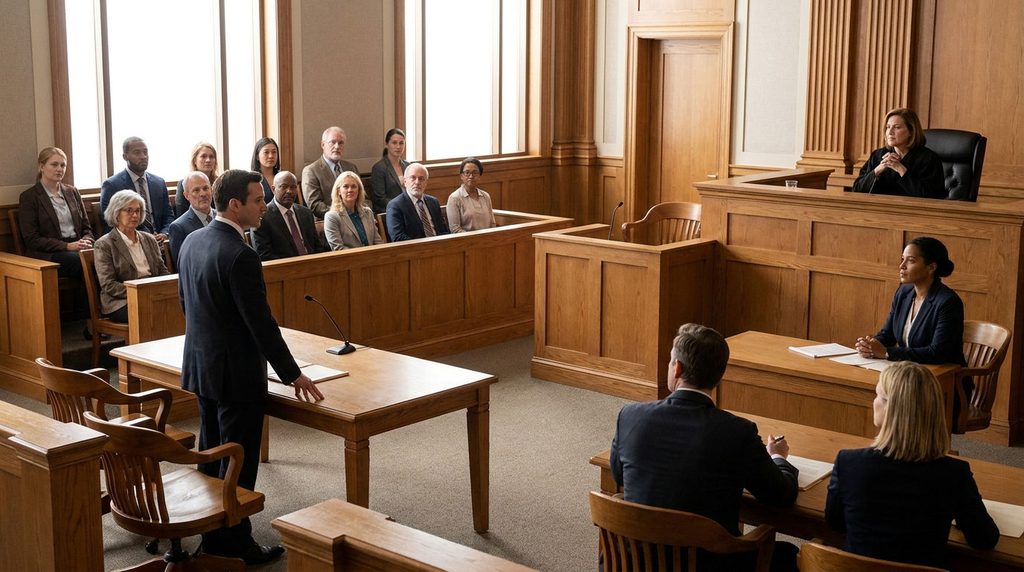
Opening statements introduce what each side expects the evidence to show. The plaintiff or prosecutor generally speaks first. The defense may then outline its position, subject to the court’s procedures.
An opening statement is not evidence, and a confident presentation does not establish that an allegation is true. Think of this stage as a proposed roadmap: the testimony and admitted exhibits still need to support the account presented.
Step 4: Witnesses Testify and Evidence Is Examined
The parties present testimony and offer exhibits, which may include documents, photographs, recordings, or physical objects. The judge decides what may be admitted under the applicable evidence rules. Jurors evaluate admitted evidence rather than everything someone wants to show them.
Admission does not guarantee that evidence is accurate or persuasive. For example, two witnesses may describe the same event differently. Jurors must assess those accounts alongside the other admitted evidence. The judge’s decision to permit testimony and the jury’s decision about how much weight to give it serve different purposes.
Direct Examination and Cross-Examination
During direct examination, the side calling a witness asks questions to establish relevant facts. Opposing counsel can then cross-examine the witness, testing memory, observations, or inconsistencies. Further questioning may follow. The Department of Justice’s trial overview describes how testimony and questioning fit into the proceedings.
What Do Sustained and Overruled Mean?
An objection challenges a question, answer, or proposed exhibit under the rules. If the judge sustains it, the judge agrees with the objection; if the judge overrules it, the objection is rejected. The court may require a question to be rephrased or direct jurors to disregard testimony. California Courts’ explanation of objections provides practical examples. A ruling on one objection does not decide the entire case.
Does a Criminal Defendant Have to Testify?
No. A criminal defendant may challenge the prosecution’s evidence without taking the witness stand or presenting evidence. The Ninth Circuit’s model jury instruction explains that proving every element of the charge remains the government’s responsibility.
Jurors also may not treat a defendant’s decision not to testify as evidence of guilt. Remaining silent is a protected choice, not an admission.
How Does Machine-Generated Evidence Fit In?
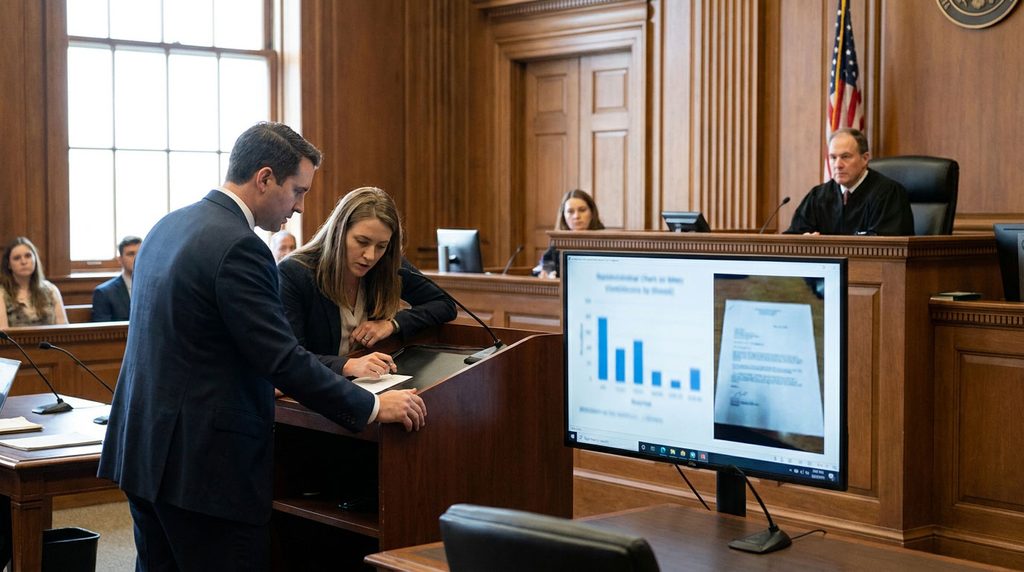
This question gives the trial process a timely technology angle. Utah’s Rule 707 on machine-generated evidence took effect on March 6, 2026. It sets reliability requirements for certain machine-generated conclusions offered without an expert witness.
That is a state-specific development, not a nationwide rule covering every digital exhibit. Its relevance is straightforward: a computer-generated conclusion is not automatically admissible simply because technology produced it. The applicable jurisdiction’s evidence rules still matter.
Step 5: Attorneys Make Closing Arguments
After the evidence closes, attorneys explain how the testimony and exhibits support their positions. They may highlight contradictions, connect facts, and address whether the required proof standard has been met.
Closing arguments are not a new opportunity to introduce evidence. They ask the decision-maker to draw conclusions from what was admitted during trial. The distinction between persuasive argument and actual evidence remains important.
Step 6: The Judge Instructs the Jury
The judge explains the governing law, the questions jurors must answer, and the applicable burden of proof. Instructions may also be given earlier; their timing is not identical in every court.
Jurors then deliberate privately, evaluating the evidence under those instructions. They determine the facts rather than rewriting the legal standard. A federal criminal verdict must be unanimous; civil verdict requirements depend on the governing rules and any permitted agreement.
Step 7: The Verdict and Next Steps
A criminal verdict addresses guilt; a civil verdict addresses the claims and questions submitted to the jury. A verdict and a judgment are related but distinct. After a criminal conviction, sentencing generally follows as a separate stage.
Some cases continue through post-trial motions or appeals. As the U.S. Courts’ appellate overview explains, federal appeals do not retry cases or hear new evidence. Appeal rights and filing deadlines depend on the case and jurisdiction.
For readers following legal news, identifying whether a report concerns a verdict, sentence, judgment, or appeal helps explain why a case may still be active even after its main trial has ended.
Understanding the Trial Process
Knowing what happens during a trial means recognizing the purpose of each stage: presenting information, testing evidence, applying the law, and reaching a decision. At Trial Explained, our goal is to make those courtroom concepts easier to follow.
This article provides general educational information, not legal advice. Laws and procedures vary by jurisdiction. Consult a licensed attorney for guidance about a specific case.